
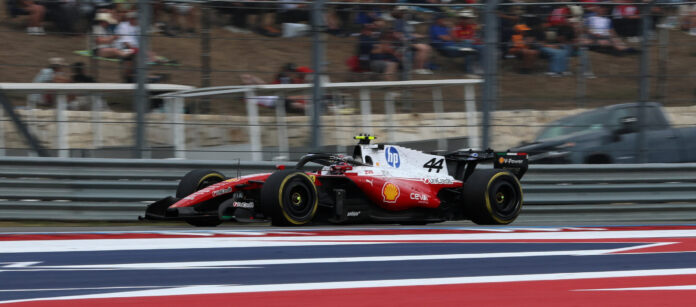
Lewis Hamilton’s first drive in a Formula 1 car was a shock that left even experienced testers questioning whether they could handle the machine. The McLaren test at Silverstone in December 2004 showed just how big a step it was from lower formulas to an Adrian Newey-era F1 car. Fellow tester Alex Lloyd later recalled that his brain could not keep up with the speed for the first few laps.
Lloyd said the feeling of being thrown back into the seat made him think he was in a spaceship rather than a race car. Speaking to Formula 1 Official, he described how different the F1 world felt compared to everything below it. It was a massive step that few drivers fully prepare for.
A Jump Too Big to Expect
Hamilton had spent his youth near Silverstone, often waking up to the sound of cars on the circuit. Still, nothing fully prepared anyone for the grunt of a Mercedes V10 in a McLaren chassis. From the moment the cars left the pits and the throttle was applied, the downforce was a shock. Lloyd later told Formula1.com that he thought he was ready after F3000 experience.
That confidence disappeared quickly. “I think none of us had ever driven anything like it,” Lloyd said. He found his mind could not track what was happening during the first couple of laps. Panic set in as he asked himself how he could possibly drive something so fast.
It took about three laps for his mind to slow down enough to process what was happening. The shift from “How the hell do I drive this?” to actually working the car was a steep learning curve. Lloyd noted it was a much bigger step than he had imagined, showing that raw talent alone does not always match the physical demands of the car.
Lessons That Still Matter Today
Those early lessons on speed and control still echo in the sport, even as the rules change. Hamilton recently spoke about how current power unit rules make racing harder in Mexico. He said the engine can go faster, but “silly clips” prevent drivers from overtaking. The result is that cars simply follow one another instead of fighting for position.
He called the engine profile setting the worst he has probably ever seen in the sport. It does not produce the kind of racing fans want to see. Hamilton believes the FIA needs to address the limits on energy deployment. High altitude in Mexico compounds the problem by making it harder to keep the cars cool.
He also suggested the track configuration could be adjusted to encourage better racing. “But everyone having this [clipping] this year just diminishes any opportunity of that,” he said, according to RaceFans. The rules stop drivers from using the slipstream to pass, which removes the excitement. Fans deserve to see overtaking, not a parade.
Team Dynamics and Mental Strength
The pressure of racing at the front also surfaces issues inside teams. After the Mexico Grand Prix, Hamilton was vocal about teammate Charles Leclerc’s approach. He said Leclerc treats situations as “do or die,” where either he wins, or none of them do. Hamilton argued that mentality costs the team points and wins.
He pointed to Silverstone earlier in the season as a contrast. Hamilton said he could have gone “all kamikaze” on Leclerc but chose to keep the team result intact instead. Functioning as a team, he said, remains essential.