
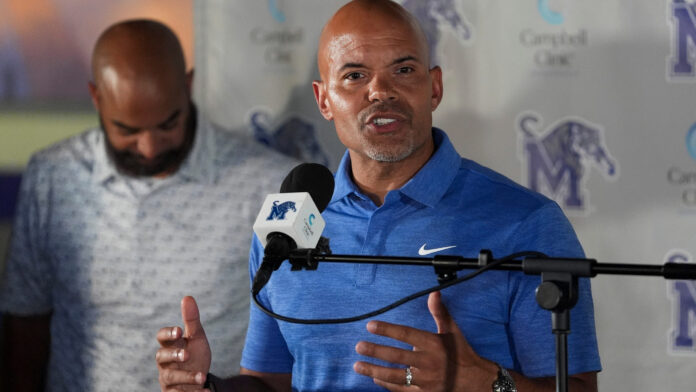
USA TODAY Sports recently heard from Memphis athletic director Ed Scott regarding a possible Group of Six playoff. He is not alone in looking for a way to add more games for schools outside the major conferences. The 24-team College Football Playoff starts in 2027, and that change has sparked talks about a second tournament just for the Group of Six.
Scott told reporters that he has spoken with other athletic directors about the idea. “I’ve talked to some other ADs about it,” Scott told USA TODAY Sports. The group wants to keep their spot in the big 24-team field while also creating a separate championship path for their best teams who do not make the main playoff.
A Companion to the Big Playoff
The plan would not replace the main tournament but work alongside it. The Group of Six could keep one automatic bid for the 24-team field. Then, an eight-team playoff could decide a champion for the teams that miss the main cut. This setup mirrors how college basketball handles its mid-major teams with the NIT.
Memphis AD Scott sees value in a dedicated title game for these schools. He noted that traditional bowl games are losing their appeal for players. “Bowl games are getting harder to get buy-in from your players, especially after the holidays,” Scott, the Memphis AD, acknowledged. A chance to win a championship at their own level might mean more to the athletes.
West Virginia athletic director Wren Baker agrees that there is a market for this extra playoff. He believes fans would tune in to see these games. Wren Baker, the West Virginia athletic director, stated, “Yes, there would be a market,” in support of a G6 playoff. He also noted that people are home during the holidays and there is space for more football on TV.
Fans and Coaches Push Back
Despite the interest from some schools, the move to 24 teams has faced heavy criticism. Nick Saban spoke out against the expansion, saying it dilutes the competition. Nick Saban remarked that “there aren’t 24 teams in the country that can win the national championship,” while regretting the disappearance of matchups such as the SEC Championship, according to The Comeback.
Even the people running the playoff admit that the public is not happy with the change. On Monday, CFP executive director Rich Clark acknowledged that “many fans aren’t in favor of expansion,” noting that the CFP weighed this view before proceeding. Urban Meyer has softened his opposition to playoff expansion, acknowledging that the parity across college football has changed his perspective. However, he remains concerned about eliminating conference championship games, which he considers an important part of the sport.
The broadcast deal with ESPN shows the financial weight behind the decision. ESPN agreed to pay the College Football Playoff an additional $345 million annually under a new five-year agreement worth nearly $1.7 billion. The deal secures ESPN’s rights to the expanded tournament through the 2031-32 season. Following conference pressure for a larger field, the network chose to retain the event instead of submitting a lowball offer in this agreement.
The SEC Stands to Gain Most
The expansion changes the math for every conference, but the SEC looks to benefit the most. A hypothetical 24-team bracket based on the current CFP rankings would include 9 SEC teams. That could give programs with three losses, and potentially even four losses, a path to the national championship that would have been much harder under the previous format.
The expansion also ends the Power Four conference championship games. The Army-Navy game, however, will retain its protected standalone window, while the Heisman Trophy ceremony moves up one week. This shift means teams like Texas and Tennessee could reach the playoff with records of 8-4 or 9-3. The extra spots allow more teams to stay in the hunt for the national title.
Scott said he does not yet have enough data to say whether a Group of Six playoff is the perfect solution. He added, “I don’t have enough data until we get to a 24-team playoff to feel strongly one way or the other.” The real test will come once the new system runs, and fans see how the games play out.