
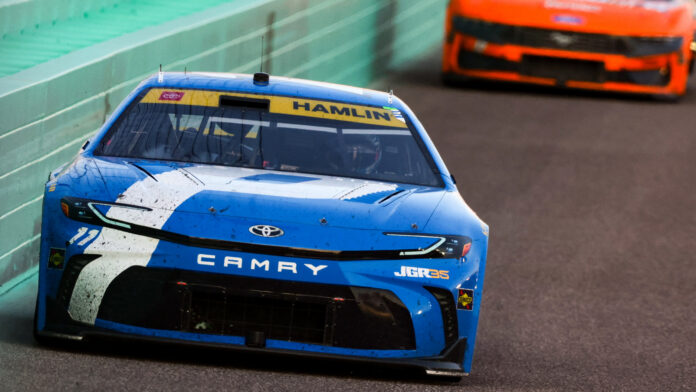
Denny Hamlin led the entire 2026 season in points but failed to win the championship. He won four Cup Series races and started the playoffs as the top seed. Kyle Larson erased a 55-point deficit to take the title at Homestead. The season showed how the playoff format can override a driver’s full-year dominance.
Hamlin finished the regular season with 1,372 total points, the highest in the field. Larson started the Chase 55 points behind Hamlin with zero regular-season wins. Nine races later, Larson held a 70-point lead. Larson clinched the title during Stage 1 at Homestead-Miami Speedway. Hamlin needed a disaster for the No. 5 car just to have a chance at the crown.
Early Season Wrecks and Pit Road Errors
Trouble started before the playoffs began. Contact involving Joey Logano and Chase Elliott at the Clash at Bowman Gray left Hamlin working back to fifth. At the Daytona 500, Hamlin battled for the lead until Justin Allgaier moved up into the No. 11. Allgaier pushed Hamlin toward the outside wall, causing a 20-car wreck. Hamlin survived that crash only to collide with teammate Christopher Bell with eight laps left. He ended the race in 31st place after two separate crashes in one weekend.
Pit road mistakes cost Hamlin valuable positions later in the year. The Chase reset wiped away earlier points gaps, but it did not fix Joe Gibbs Racing’s pit stops. Hamlin spent the final 10 races trying to recover positions he lost on pit road or in traffic. A victory in June could easily turn into a loss of 20 or 30 points in September due to these recurring errors.
How the Format Changed the Outcome
Due to the postseason reset, the playoff format enabled Larson to accumulate 248 points over the leader. Just three races after the playoffs began, this system allowed Larson to assume the lead. He never looked back after that point. A driver who failed to secure any regular-season victory claimed the championship. For the 14th occasion across 23 postseasons, the full-season points leader lost the actual title.
Hamlin managed to save many races despite bad luck. He won at Las Vegas after two pit-road penalties. He won at Nashville after jumping the start. After starting from the rear and spinning to evade a crash, he secured a victory at Michigan. He did not record a single DNF all season despite damaged cars and mechanical problems. The No. 11 possessed sufficient speed to escape trouble nearly as fast as it encountered it. Yet the format reset erased his hard-earned buffer.
Why Full-Season Points Would Have Worked Better
Many fans argue the points system is the only fair way to decide a champion. For the past 23 years, calculations have shown who the “rightful” champion would be without resets. NASCAR got rid of the “win and in” knockout format used from 2014 to 2025. Even with the return of a Chase-style system, these debates continue. The data shows Hamlin led the series in total points over all 36 races. Ryan Blaney finished second with 1,270 points, 102 points behind Hamlin. Tyler Reddick came in third with 1,226 points. Larson finished fourth with 1,180 points, trailing Hamlin by 192 points.
The gap between Hamlin and Larson in the final standings proves the point. If NASCAR simply used points with no postseason resets, Hamlin would be the champion. This view comes from analysis by Beyond The Flag. Observers pointed out that the series points leader ultimately was not crowned champion. The system rewarded a specific stretch of performance over the entire year’s consistency.