
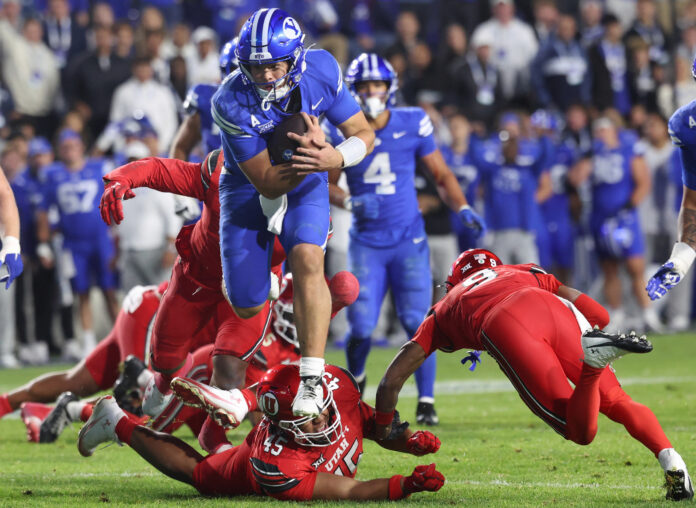
The best BYU players in the Holy War during the 1970s and 1980s were quarterbacks Marc Wilson, Jim McMahon, and Steve Young. Marc Wilson set a single-game passing record in 1977 that still stands today. Jim McMahon led the Cougars to their largest victory margin in the rivalry in 1980. Steve Young entered the program behind McMahon on the quarterback depth chart.
BYU and Utah have played over a century of games against each other. The rivalry has always been fierce, but the 1970s and 1980s changed the stakes forever. According to Yahoo Sports, the hatred between the two schools grew into something much bigger during these decades. The games stopped being just about bragging rights and started defining careers. Fans in Provo and Salt Lake City remember these players because they delivered when it mattered most.
The Record-Setting Era of Marc Wilson
From 1977 to 1979, Marc Wilson was a player for the Cougars. He dominated the Western Athletic Conference in almost every passing category. Wilson led the league in completions, completion percentage, total yards, and touchdowns. He also topped the charts in yards per attempt and yards per game. His performance in 1977 remains the high point for passing in the history of the Holy War.
In that 1977 game, Wilson threw for 571 yards. This number set a new NCAA single-game record at the time. That total remains the largest passing yardage total ever seen in a Holy War game. Coach LaVell Edwards made a bold move late in the fourth quarter. With BYU already leading by a large margin, he put Wilson back in the game. The goal was to break the record, and Wilson delivered.
Wilson’s decision to stay in the game changed the nature of the rivalry. It showed that the game was about more than just two Utah teams playing each other. Utah head coach Wayne Howard recognized the shift immediately. He told reporters, “The hatred between BYU and Utah is nothing compared to what it will be.” Howard added, “It will be a crusade to beat BYU from now on.” Wilson’s record forced Utah to take the game to a new level of intensity.
Jim McMahon’s Dominant 1980 Season
Jim McMahon took over the starting job before the 1980 season. He put together a year that Cougars fans will never forget. McMahon threw for 4,571 yards and 47 touchdowns that season. He averaged almost 400 yards per game, which was a massive number for that era. His leadership turned the BYU offense into a scoring machine that no one could stop.
The 1980 Holy War game showed McMahon’s talent at its peak. He threw for 565 yards and four touchdowns in a single game. The final score was 56-6, which stands as the largest margin of victory in the rivalry’s history. Utah had no answer for McMahon’s arm or his ability to run. The game was a blowout that cemented his place in school history.
Cougars fans will never forget the 1980 season Jim McMahon assembled before he led the Bears to their only Super Bowl victory. His performance that year proved that BYU could compete with any team in the country. The 56-28 win over Utah was the crowning achievement of that season. It showed that the Cougars were ready to be a national power, not just a regional team.
The Transition to Steve Young
When Jim McMahon’s time at BYU ended, Steve Young stepped in. McMahon’s final season was Steve Young’s first in Provo. Young did not have to wait long to make his mark. He brought a new style of play that kept the offense moving forward. The transition from one great quarterback to another happened smoothly because the program had built a strong foundation.
Young’s arrival ensured that the rivalry continued to produce high-level football. He carried the torch that Wilson and McMahon had lit. The 1980s ended with BYU still at the top of the conference. Their stats and records are still talked about by fans today.
The list of best players does not consider a player’s complete body of work. The piece examines the finest Holy War moments from the past fifty years. These three men stand out more than all the others over the last 50 years. They turned the game into a must-watch event every time they took the field.
Why These Decades Still Matter
The 1970s and 1980s set the standard for what the Holy War means. Before these decades, the game was just another conference matchup. After these years, it became a battle for the soul of Utah football. The records set by Wilson, McMahon, and Young are hard to beat.
They remember the feeling of watching a national record get broken. They remember the joy of a 56-point victory over a hated rival. The hatred and the passion that Howard predicted in the 1970s are still alive.
Debates about the best rivalries happen every year in college football. In 2026, there is no debate. This year, no other rivalry in the sport will carry as much meaning as the Holy War. The history of the 1970s and 1980s proves why.